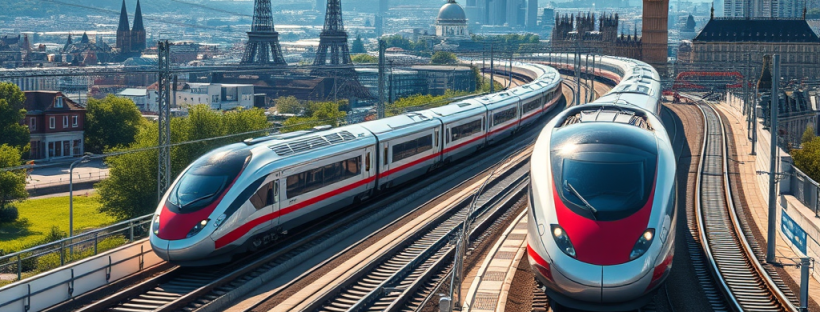
The recent Euronews article titled “The European Tube: Inside the project to launch a continent-wide rail system by 2040” introduces the ambitious Starline network, aiming to connect 39 European destinations with high-speed trains traveling at 300-400 km/h. This vision includes extending lines to the UK, Turkey, and Ukraine, promising significantly reduced travel times across the continent. euronews+1The Sun+1
While such proposals capture the imagination, they often border on utopian ideals, reminiscent of “Luftschlösser”—castles in the air—that risk fostering unrealistic expectations. The convergence of advanced AI models like ChatGPT with think tanks can sometimes amplify these speculative visions. When AI-generated content meets policy-driven organizations, there’s a potential for creating scenarios that, while innovative, may lack practical feasibility.
The Starline project exemplifies this phenomenon. While the concept of a unified, ultra-fast European rail network is enticing, the challenges—ranging from infrastructural overhauls and astronomical costs to geopolitical complexities—are immense. Historically, advancements in rail transport have been incremental. For instance, Europe’s expansion of long-distance train routes has been a gradual process, focusing on enhancing existing networks and improving cross-border collaborations. The Sun+1euronews+1euronews
Innovation is undeniably vital for progress. However, it’s crucial to ground visionary ideas in realism. At this juncture, while AI can assist in modeling and simulating potential developments, the stewardship of tangible innovation should remain firmly in human hands. Human expertise ensures that advancements are not only visionary but also achievable, taking into account the multifaceted challenges that come with large-scale infrastructural projects.
In conclusion, while the fusion of AI insights and think tank aspirations can generate exciting concepts, it’s imperative to distinguish between visionary ideas and practical realities. By focusing on achievable, incremental improvements, we can ensure that the evolution of rail transport remains both innovative and grounded.
 mobilistics